| List Price: | ||
| Price: | $18.70 | |
| Discount: | $6.25 (Save 25%) |
 eBooks
| List Price: | ||
| Price: | $18.70 | |
| Discount: | $6.25 (Save 25%) |
Overview
The 1967 Outer Space Treaty designated space as the “province of all mankind.” It expressly prohibited nuclear and non-nuclear weapons of mass destruction in orbital space and exclusively limited the use of the Moon and other celestial bodies for “peaceful purposes.”
But changes in the post–Cold War world, as well as unforeseeable advances in satellite and weapons technologies, have compelled every space-faring nation—save the U.S. and Israel—to go on record as favoring a new treaty for the Prevention of an Arms Race in Outer Space.
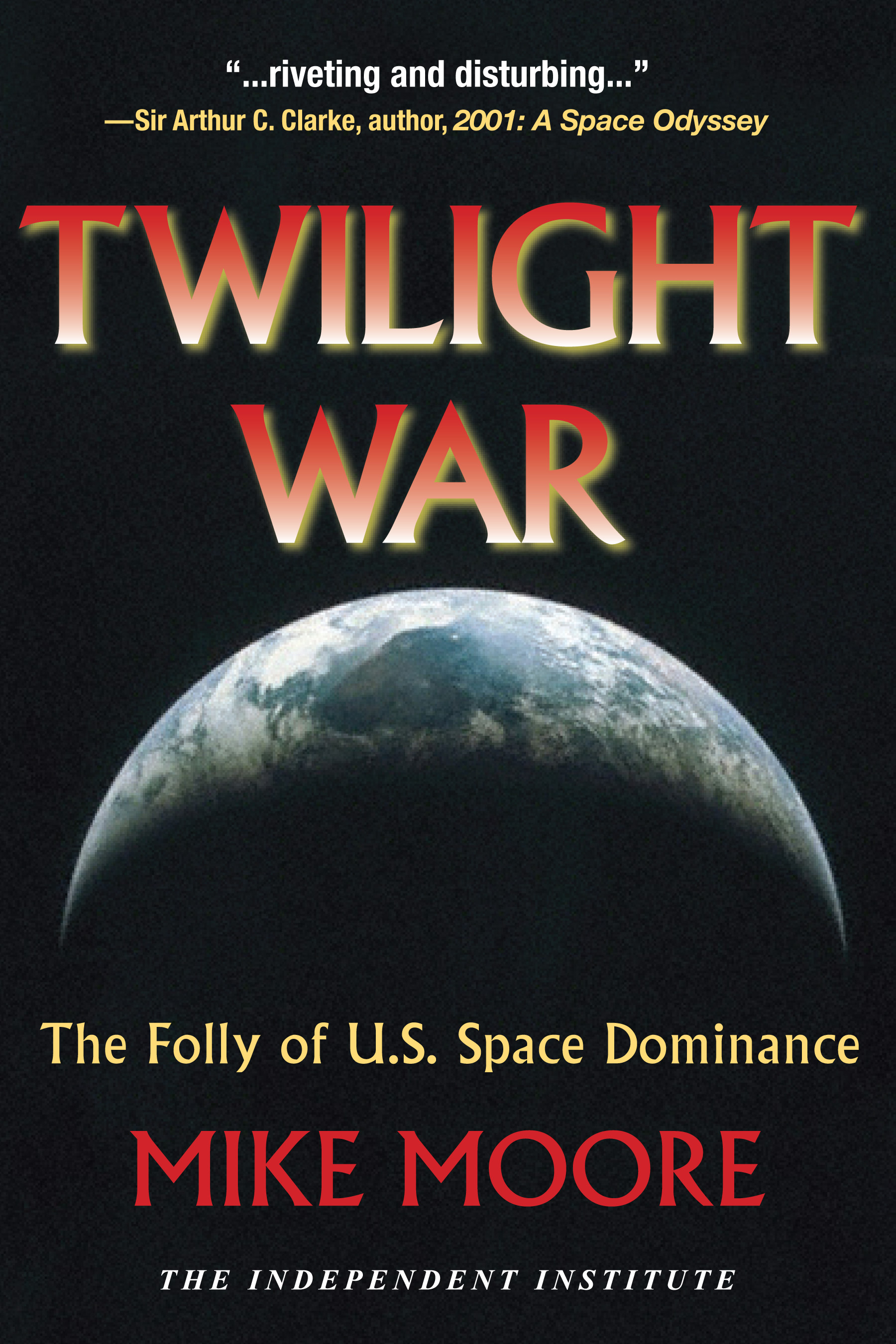
In Twilight War: The Folly of U.S. Space Dominance, Mike Moore, former editor of The Bulletin of the Atomic Scientists, argues that the U.S. merely provokes conflict when it presumes to be the exception to the rule. Rejecting treaty negotiations while further militarizing space renders America unable to lead by example. Moore concludes that instead of trying to stop an arms race in space by starting one, the U.S. must radically rethink its strategy.
Contents
-
Acknowledgments
Preface
Introduction
1. Triumphalism in Space
2. Full Spectrum Dominance
3. Nightmare Scenarios
4. Joined at the Hip
5. Prompt Global Strike
6. Put to the Sword
7. True Space Ships
8. Guardian of the Peace
9. The Right Question
10. Open Skies, Space Spies
11. The Freedom of Space
12. The Road Not Taken
13. The Americanization of the World
14. The New Utopians
15. The Next Cold War?
16. The Irony of American History
Appendix A / Into Space, Anonymously
Appendix B / Newton’s Cannon
Appendix C / Space Control—A Very Old Idea
Appendix D / From Silverbird to FALCON
Appendix E / Useful Websites
Notes
Index
About the Author
Detailed Summary
- For many years, President Eisenhower’s vision of “space for peaceful purposes” has been under attack by self-proclaimed “space warriors” who believe American security requires that the United States seek to militarily dominate space. Their program calls on the U.S. to pursue “space control” that includes the capacity to “deny others the use of space” so that other nations cannot “level the military playing field.” The space warriors have had considerable bipartisan influence in the military, think tanks, Congress, and several presidential administrations. Their ideas are particularly welcome among those who have championed President Bush’s war in Iraq.
- Other nations, especially China, have said that by pursuing space dominance, the United States will likely provoke an arms race in space. China fired a “shot across the bow” in January 2007 by destroying one of its aging satellites with a newly developed anti-satellite weapon, replicating a test the United States conducted in 1985. Such orbital adventurism portends danger in the future, especially if the United States projects an air of triumphalist nationalism and exceptionalism toward other countries, or says it will forbid other nations from pursuing the same space technologies.
- The tension between those looking at the heavens and imagining peaceful exploration and those conceiving more efficient warfare goes back hundreds of years to the advent of hot air balloons. In the heat of the Cold War, the United States and the Soviet Union put diplomacy ahead of belligerence and signed an international space treaty that emphasized the designation of space as “the province for all mankind.” After half a century of major geopolitical changes as well as advancements in satellite, microprocessor, and weapons technologies, the vast majority of spacefaring nations now seek a new, updated space treaty to reaffirm the international commitment to a peaceful orbital space—but Washington, D.C. has been obstructing these negotiations. Whereas cooler heads once prevailed and kept the Cold War from ruining space, the mentality of some U.S. leaders today remains as hawkish as ever.
- The troubling legacy of modern warfare—from strategic bombing and total war to the doctrines of Mutually Assured Destruction and preemptive strikes—has profound implications for the militarization of space. The tragic ironies of war, such as how efforts to minimize civilian casualties or defend against weapons of mass destruction can actually encourage more military interventions, are even more unsettling in the frontier of space, as the stakes are much higher. Understanding the historical context of the current drive to dominate and weaponize space will be crucial preparation for what could be one of the most important debates of this century.
The 1967 Outer Space Treaty, inspired largely by President Eisenhower, designated space as the “province of all mankind.” It expressly prohibited weapons of mass destruction in orbital space and limited the use of the Moon and other celestial bodies to “peaceful purposes.” But changes in the post–Cold War world, as well as unforeseeable advances in satellite and weapons technologies, have compelled every space-faring nation—save the U.S. and Israel—to go on record as favoring a new treaty for the Prevention of an Arms Race in Outer Space.
In the grand tradition of American exceptionalism, Washington has been adept at avoiding the issue. The administrations of Ronald Reagan, George H. W. Bush, Bill Clinton, and George W. Bush have blocked negotiations, citing potential threats to U.S. “rights, capabilities, and freedom of action.” Self-proclaimed “space warriors” even argue that U.S. military dominance in orbital space will be the only guarantee for international peace in the future.
But in Twilight War: The Folly of U.S. Space Dominance, Mike Moore, former editor of The Bulletin of the Atomic Scientists, argues that the U.S. merely provokes conflict when it presumes to be the exception to the rule. Rejecting treaty negotiations while further militarizing space renders America unable to lead by example. “Unilateral military actions in space will not guarantee American security; they will guarantee conflict, and possibly, a new cold war,” Moore concludes. Instead of trying to stop an arms race in space by starting one, the U.S. must radically rethink its strategy.
The Space Warriors
Twilight War does not question the motives of the space warriors. But it does question their ideas and plans. The first two chapters introduce the concept of unilateral space dominance. The U.S. Space Command, Air Force Space Command, and the congressionally mandated Space Commission, chaired by Donald Rumsfeld in the months before he became Secretary of Defense, have issued reports advocating U.S. dominance in space. Space dominance is not yet national policy, but the space warriors are pushing the United States in that direction.
Chapters Three, Four, and Five explain the space warriors’ reasoning: Because America’s new approach of precision war requires the intense use of space “assets,” the United States must preemptively develop the means to protect those assets, in part by neutralizing the satellites of other nations. Already the United States has an effective antisatellite system in the guise of its national missile defense system. This system is unlikely to work well if missiles are ever launched against the United States, but it would work well if used in an offensive mode against the satellites of other nations. Space warriors call this “space control.”
Precision War, Spy Satellites & Eisenhower’s Wisdom
Chapters Six through Eleven provide the historical background for understanding the militarization of space. Chapter Six—“Put to the Sword”—takes you back to the years after World War I, when the uniquely American concept of “precision warfare” began to emerge. Precision bombing was supposed to be a new and humane way of fighting wars. Wars would be brief because the enemy’s war-related industries and infrastructure could be targeted, making it impossible for the enemy to continue fighting. In addition, precision attacks would save civilian lives.
It didn’t work out that way. Hundreds of thousands of German and Japanese civilians died in the early attempts at “precision” war. Today, the United States has improved marginally, sparing civilian lives more than in previous modern wars. A variety of space satellites allows for such precision. Space warriors say that these space assets must be protected. But, Twilight War asks, how best to protect these assets? Is unilateral space dominance the way? Or is a tough and fully verifiable space treaty the answer?
Chapters Seven and Eight examine the rise of the space-dominance paradigm. As early as May 1946, Project RAND, then an Air Force think tank, predicted that Earth satellites were possible. They would help in establishing reliable global communications, predicting weather, conducting scientific research, and waging war. “After observation of its trajectory,” RAND said of a possible weapons satellite, “a control impulse can be applied in such direction and amount, and at such a time, that the satellite is brought down on its target.”
Chapters Nine through Eleven emphasize the wisdom of President Eisenhower, who came under intense pressure after Sputnik to take military control of space. Eisenhower would have none of that. Extending the East-West arms race into space would only worsen U.S.-Soviet tensions. The idea was to ease tensions, not exacerbate them.
The value of space, Eisenhower believed, lay mostly in spy satellites. Rather than guessing about Soviet intentions, U-2 planes and spy satellites would deliver hard data about what the Soviets were actually up to. “Without [aerial reconnaissance],” Eisenhower told a colleague, “you would only have your fears on which to plan your own defense arrangements and your whole military establishment.... Now if you’re going to use nothing but fear and that’s all you have, you are going to make us an armed camp. So this kind of knowledge is vital to us.” The hard data revealed that the United States far outpaced the Soviet Union militarily, a reality that freed the president to pursue a peace agenda.
The Road Not Taken
Chapter Twelve argues that the best way for the United States to secure space for itself and the other forty-plus spacefaring nations is by leading negotiations for a fully verifiable space treaty that would prevent any nation, including the United States, from developing space-related weapons.
The United States holds high the banner of the rule of law on every continent. Why not at least engage in serious treaty talks? The final chapters attempt to answer that question, in part, by linking the dream of unilateral space dominance to the grand old tradition of American exceptionalism—the notion that the United States, and only the United States, is free to do what it wants on the world’s stage, perhaps because Providence has favored it above all other nations.
Some, including Mike Moore, believe that the florid rhetoric of “manifest destiny” is a dangerous and self-defeating expression of national hubris. To many of today’s space warriors, such expressions seem like truth and ample justification for America’s dominance of space.
Twilight War concludes with four appendices. The first recounts old dreams of space travel—and how even early visionaries foresaw weapons in space. Appendix B explains how satellites stay in orbit. Appendix C links the notion of space control to the much older concept of dominating the air. Appendix D demonstrates that for more than six decades space warriors have dreamed of having a spacebomber—and even as you read this, the dream lives. The final appendix—“Useful Websites”—is a must for those who wish to become experts on the subject.
Praise
“Sixty years ago I wrote ‘We will take no frontiers into space.’ Twilight War presents riveting and disturbing evidence that some nations are attempting just that—making the heavens unsafe for us all.”
—SIR ARTHUR C.CLARKE, author of 2001: A Space Odyssey
“Twilight War is a tour de force.”
—THERESA HITCHENS, Director, Center for Defense Information, author of Future Security in Space: Charting a Cooperative Course
“A well-balanced, comprehensive and clearly written analysis that examines the critical issue of space policy in the context of international security and fundamental American values.”
—LT. GENERAL ROBERT G. GARD, JR., (USA, Ret.), Senior Military Fellow, Center for Arms Control and Non-Proliferation
“Moore’s gripping and masterful account of war and law in space should be required reading.”
—JOHN C. POLANYI, Nobel Laureate in Chemistry, University of Toronto
“Is the militarization of space inevitable? According to Mike Moore, former editor of the Bulletin of the Atomic Scientists, U.S. space policy increasingly proceeds on the assumption that it is. If this continues, the militarization of space will become a self-fulfilling prophecy. . . . Twilight War is an authoritative study of this new security problem and a highly readable and richly detailed historical account of people, institutions, technologies, and ideas from the invention of the airplane to China’s January 2007 ASAT test. . . . Moore’s presentation of space warrior ideology, and critique of it, is lucid and thorough. He also brilliantly chronicles the rise of the military-industrial complex, especially the symbiosis between Air Force and aerospace interests going back to its origins in World War I. . . . Mike Moore’s book is timely, learned, and important. The future of space is currently being decided in corporate boardrooms and Pentagon offices, with the quiet complicity of Congress, Twilight War—which is a page-turned—launches the informed debate on U.S. space policy that democracy requires.”
—POLITICAL SCIENCE QUARTERLY
“An indispensable resource for anyone looking to get smart on a possible new cold war—in space. Wide-ranging research and an elegant writing style make for an easy tutorial.”
—JOSEPH CIRINCIONE, Vice President for National Security, Center for American Progress
“Mike Moore, former editor of the Bulletin of the Atomic Scientists, presents a straightforward thesis early in Twilight War: If a cold war develops in space, the United States will have incited it; if the United States refrains from a ‘policy of space dominance,’ a new cold war is less likely. What follows is a wide-ranging history of not only space technology, but the ideas that drive early air-power theorists and ‘space warriors.’ Reaching as far back as Athenian democracy, the author argues that hubristic beliefs in exceptionalism, as he sees in much of the U.S. rationale for space dominance, is ultimately dangerous and risks understandable rejection by others in the international community. Instead, he calls for the United States to engage in efforts to conclude a new space treaty, despite the difficulties of verification and U.S. development of missile defense, which is akin to some antisatellite technology.”
—ARMS CONTROL TODAY
“Twilight War is an exceptional work, intellectually honest and refreshing. The research is solid and the inferences made from it are fully supportable. Twilight War will quickly become a must-read in the field.”
—EVERETT C. DOLMAN, Professor of Comparative Military Studies, Air Force School of Advanced Air and Space Studies, author of Astropolitik: Classical Geopolitics in the Space Age
“An excellent and thorough work. A significant addition to the literature of the important issue of space security.”
—AMBASSADOR THOMAS GRAHAM, JR., Chairman of the Cypress Fund; Senior U.S. Diplomat for arms control and non proliferation, 1970–1997
“Mike Moore does a wonderful job describing the forces that are pushing the United States to further militarize space and dominate it. And an equally good job of demonstrating that an arms race in space might very well have regrettable consequences for America and the world.”
—JOHN J. MEARSHEIMER, R. Wendell Harrison Distinguished Service Professor of Political Science, University of Chicago, author of The Tragedy of Great Power Politics
“Twilight War provides clear insight as to what we should expect—and demand—from our political leadership to ensure that outer space remains a resource for all and a security threat to none.”
—JEFFREY BOUTWELL, Executive Director, Pugwash Conferences on Science and World Affairs
“[Twilight War] examines the development and use of ASAT as part of a general philosophy espoused in some quarters for ‘space dominance’: the ability by the United States to control who can access and use space. . . . The book, Moore writes, ‘is more about values than technology,’ and much of the book is indeed devoted to issues of values and policy rather than technology. This includes discussion of historical and policy background on issues ranging from the establishment of the ‘freedom of space’ concept that allowed satellite overflights to the doctrine of precision bombing to the concept of ‘American exceptionalism,’ which in the eyes of its proponents puts America above the other nations in the world and makes it free to do whatever it wants in world affairs. These concepts can at times seem far afield from the issues of space weaponization and space dominance, but Moore ties them all together by the end of the book. . . . Twilight War does offer a guide to future administrations on why an arms race in space can be prevented.”
—THE SPACE REVIEW
“Mike Moore’s book, Twilight War: The Folly of U.S. Space Dominance, is written with lay readers in mind. Moore, a former editor of the Bulletin of the Atomic Scientists, writes with clarity and passion against the policy preferences of U.S. ‘space warriors.’ Moore is interested primarily in the military uses of space, a narrower focus than Space as a Strategic Asset, but one that leaves room for many digressions about the history of airpower and U.S. exceptionalism, which he believes is one of the root causes of unwise U.S. military space policy. Some readers may take issue with the extent of these digressions; this reviewer learned from them. . . . Since nations that have the ability to launch satellites also have the ability to harm them, Moore’s injunction about the military uses of outer space is simple, straightforward, and entirely sensible: ‘Do not do unto others what you would not like them to do unto you.’ Moore’s prescriptions for a new treaty will not be easy to implement. . . . Moore has done an admirable job describing a problem that does not lend itself to ambitious or simple solutions. He postulates an either/or policy choice between the pursuit of space dominance or a treaty to prevent an arms race in outer space.”
—NONPROLIFERATION REVIEW
“Mike Moore’s book provides a much needed look at the misguided state of U.S. space policy, making an effective case against the space weapons which currently seem on the policy agenda. . . . For those less familiar and less opinionated on the topic, it is guaranteed to inform through a richly woven combination of largely historical, political and philosophical considerations, and all in a very readable manner attributable to Moore’s background in journalism. It is wide-ranging in consideration of viewpoints and careful in documentation. . . . Everyone will benefit from reading Moore’s book, from lay readers—the crucial audience that must be reached if U.S. policymakers are to be persuaded to make serious course changes—to space enthusiasts and the space policy community at large. This is a topic ignored to the peril of all Americans.”
—SPACE TIMES
“Twilight War puts forward two well-articulated lines of argument. The first is that achieving U.S. space control is technologically and fiscally extremely unlikely, given the increasing space capabilities of other countries, not only Russia but also China, India, Japan, and the nation-states of Europe. The second is that rather than being consistent with U.S. values, ‘building and deploying the capability to unilaterally control space and place weapons in space would not square with America’s historic reverence for liberty and the rule of law.’ . . . Twilight War is a very useful addition to the growing body of thinking and writing that opposes moves to weaponize space and that advocates multilateral approaches to space security. . . . The book is a reminder that the ability to operate in space free from the threats of disruption is essential to the modern world, and both provide an ultimately optimistic assessment that it is possible to get to such a state of affairs.”
—ISSUES IN SCIENCE AND TECHNOLOGY
“Mike Moore (not the film producer) has been a journalist and the editor of The Bulletin of the Atomic Scientists, and is a professional pundit on space and security policy. His book’s focus, he writes, is ‘more about values than about technology’. Indeed, he calls his book a ‘biography of an idea’, of the United States and its evolving policy to control near-earth space and put weapons there. His title, Twilight War, calls attention not only to satellites traveling between space and darkness, but to decisions being quietly made in the shadows. . . . Obama’s advisors should read this book if only to have a better sense of what they are up against and what arguments of the skeptics and critics are. One can learn a lot from them. The book is a sign that there is another intellectual and policy debate to be waged as we struggle to find the right answers to these questions.”
—INTERNATIONAL HISTORY REVIEW
Author
Mike Moore is a Research Fellow at the Independent Institute and former editor of The Bulletin of the Atomic Scientists, a science-oriented peace-and-security magazine founded by key members of the Manhattan Project. He has been a reporter and editor for the Kansas City Star, Chicago Daily News, Chicago Tribune, and Milwaukee Journal, as well as the editor for Quill, the magazine of the Society of Professional Journalists. In addition to his work in journalism, he served on the Council on Foreign Relations Study Group “U.S. Space Posture for the 21st Century,” the Eisenhower Institute’s “Space Security Working Group on the Future of Space,” and the Stanley Foundation task force “Winning the Peace in the 21st Century.” He lives in Missouri with his wife, Sandy.
Awards
2009 Independent Publisher Book Awards (IPPY Awards)
- Silver Medal Winner in Science
2009 IBPA Benjamin Franklin Awards
- Winner in Political/Current Events